Take this line from Ask Crump’s fictional product-operations résumé sample:
Built launch-readiness reviews across product, sales, support, and marketing, improving on-time enablement from 68% to 92%.
It reads cleanly. It also makes several factual claims: the person built the reviews, four functions used them, “on-time” had a definition, performance began at 68%, performance ended at 92%, and the change was connected to the person’s work. Every claim needs support.
That is a useful role for AI in résumé work. It can help organize and sharpen what happened. It cannot turn a plausible sentence into a true one.
What this example is—and what it is not
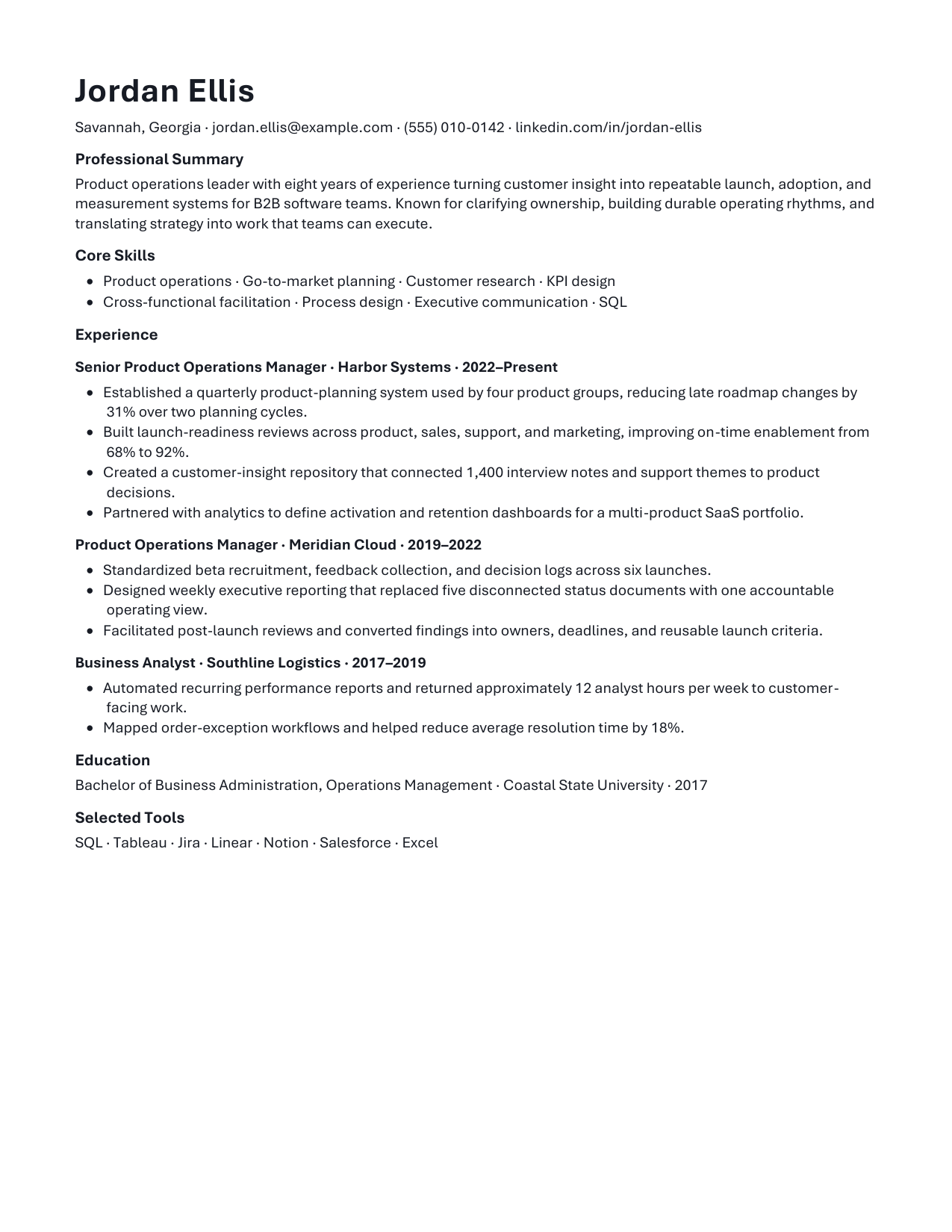
The real Word exporter produced this document structure and render. The wording came from a frozen internal quality fixture. The name, employers, school, contact details, dates, tools, and metrics are fictional.
No applicant or customer is represented. No founder résumé, testimonial, private career record, or hiring outcome is shown. This page does not claim that a live Ask Crump conversation generated the fictional career history or that anyone received an interview or job.
Its bullets are specific enough to expose the exact facts a real applicant would need to verify.
The five questions behind a defensible bullet
What did you personally do?
Underline the action you can own. “Built,” “led,” and “created” imply responsibility. If you contributed to work owned by someone else, “supported,” “partnered on,” or “contributed to” may be more accurate and can still be valuable.
What was the real scope?
Check every team, location, product, customer group, and time period. “Across four functions” is different from “with representatives from four functions.” “Company-wide” is not a harmless synonym for “used by my team.”
Can you reproduce the number?
Keep the source, date range, definition, numerator, denominator, and calculation. If you cannot explain why a metric changed from 68% to 92%, do not present it as settled fact.
Does the sentence overstate cause?
“Improved” often reads as “my work caused this result.” If several changes happened at once, describe the work and observed result separately until the causal claim is supportable.
Could you explain it without the résumé?
An interviewer may ask what changed, who disagreed, how you measured the result, and what you would do differently. If the bullet falls apart after two follow-up questions, revise it before applying.
A claim-by-claim audit of the sample
Because Jordan Ellis is fictional, this table does not certify any career claim. It shows what evidence a real applicant would need before using comparable wording.
| Sample résumé claim | What it implies | Evidence to check | Safer wording when proof is incomplete |
|---|---|---|---|
| “Used by four product groups” | Four distinct groups adopted the planning system. | Rollout list, meeting records, planning artifacts, owners, and dates. | “Introduced a quarterly planning system for multiple product groups.” |
| “Reducing late roadmap changes by 31%” | The same metric was measured before and after, and the work materially contributed. | Definition of “late,” baseline and comparison windows, change counts, denominator, and other interventions. | “Tracked late roadmap changes across two planning cycles.” |
| “Improving on-time enablement from 68% to 92%” | Timing had a stable definition and the comparison is valid. | Launch list, deadline definition, numerator, denominator, reporting period, and ownership. | “Built cross-functional launch-readiness reviews and monitored on-time enablement.” |
| “Connected 1,400 interview notes and support themes” | The repository truly contained that volume and made the sources usable together. | Repository count, deduplication rule, capture date, theme method, and access boundaries. | “Created a searchable repository connecting interview notes with support themes.” |
| “Returned approximately 12 analyst hours per week” | Time was measured or estimated consistently and the saved work went somewhere useful. | Before-and-after task sample, analyst count, calculation method, observation period, and downstream use. | “Automated recurring reports and reduced weekly manual reporting work.” |
| “Helped reduce average resolution time by 18%” | The reduction is real, the time window is comparable, and the contribution is bounded. | Issue cohort, start and end definitions, baseline, comparison window, confounders, and team contribution. | “Mapped order-exception workflows and supported a resolution-time improvement initiative.” |
The safer versions are fallbacks, not automatic improvements. If the evidence exists, keep the specific claim and retain the records that explain it.
A prompt that keeps the facts in charge
Before using Ask Crump—or any writing tool—assemble a small evidence bank. Use only material you are allowed to share.
I am applying for [role]. Below are facts from my actual work and the target job description.

For each proposed résumé bullet:
1. use only facts present in my evidence bank;
2. label any unsupported claim, number, scope, title, tool, or causal statement;
3. separate what I did from what the team did;
4. preserve dates, units, and definitions exactly;
5. give me a specific version and a conservative version;
6. list the evidence I should verify before applying.

Do not invent metrics, employers, credentials, tools, responsibilities, or outcomes. If a detail is missing, ask me for it instead of filling the gap.

Evidence bank:
[paste accurate facts]

Target role:
[paste only material you are allowed to use]
The prompt is deliberately less glamorous than “make my résumé amazing.” It gives the tool a useful job: make the evidence easier to understand without quietly changing it.
Review the file, not just the paragraph
Ask Crump can package a résumé as an editable Word document. The final review still belongs in the file you will submit.
- Open the
.docxin the software you will use to deliver it. - Confirm your name, contact details, links, employers, titles, dates, education, and credentials.
- Compare every number with its source and check that verb tense matches the employment dates.
- Remove confidential or employer-owned details you are not authorized to disclose.
- Use one or two pages only when that length suits the role—not because a template forced it.
- Read the résumé aloud and prepare a short explanation for every bullet.
- Export to PDF only if the application requests or accepts it, then inspect that final file separately.
Readable headings and restrained formatting can help, but no layout guarantees parsing by every applicant tracking system. No wording guarantees ranking, recruiter approval, an interview, or a job.
Turn accurate evidence into a résumé you can defend.
Bring the target role and the facts behind your work. Ask Crump can help shape an editable draft; you remain responsible for every claim, file, and application.
Evidence and method
The displayed résumé was produced by Ask Crump’s current Word exporter from a frozen, fictional internal quality fixture and inspected for readable hierarchy, native editable text, page boundaries, and clipping. The render’s SHA-256 is 380DEBEDDC271D085BD80D593F01CDF8DA79AAF426CC3E3B3613D90E3AABFDF4. It is product evidence—not a customer story or hiring-performance claim.